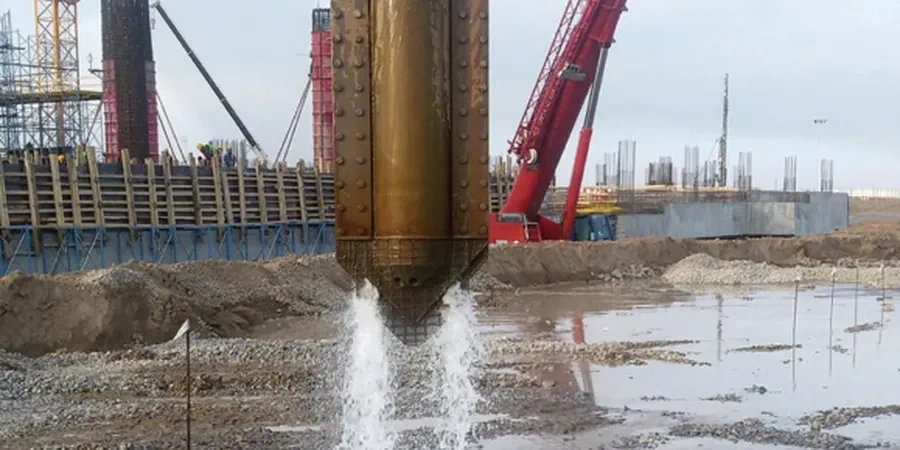
Ground improvement in Auckland is a critical geotechnical discipline focused on enhancing the engineering properties of soils to safely support infrastructure and buildings. This category encompasses a suite of specialized techniques designed to increase bearing capacity, reduce settlement, and mitigate liquefaction potential. From the volcanic landscapes of the isthmus to the alluvial plains of South Auckland, the region's complex geology often demands tailored solutions. Services such as stone column design and vibrocompaction design are fundamental for densifying loose granular deposits, ensuring long-term stability for residential subdivisions and commercial warehousing.
Auckland's geological setting is uniquely challenging, dominated by the remnants of a monogenetic volcanic field, residual Waitemata Group sandstones and siltstones, and deep Holocene marine and alluvial sediments. Soft, compressible clays and loose, water-saturated sands are common, particularly in coastal reclamation areas like Wynyard Quarter and along the Tamaki Estuary. These soils are highly susceptible to settlement and, critically, earthquake-induced liquefaction. The presence of high groundwater tables further complicates excavation and foundation work, making dewatering and ground modification essential before construction can commence on any significant scale.
The regulatory framework for ground improvement in New Zealand is stringent, driven by the seismic risks outlined in the Building Code. All designs must comply with the New Zealand Building Code Clause B1 (Structure), which references AS/NZS 1170 for structural design actions and, most pertinently, the Ministry of Business, Innovation and Employment (MBIE) guidance on earthquake geotechnical engineering. Specifically, the MBIE/NZGS Module 5 on ground improvement of foundations provides the definitive methodology for verifying performance against Ultimate Limit State (ULS) and Serviceability Limit State (SLS) criteria. Practitioners must demonstrate through rigorous testing, such as Cone Penetration Tests (CPT) and plate load tests, that the treated ground meets the required strength and stiffness parameters, with a clear focus on post-liquefaction volumetric reconsolidation settlement.
A wide array of project types in Auckland rely on these improvement methods. Large-scale earthworks for motorway extensions and industrial parks on the city's fringes often require mass ground treatment like dynamic compaction design to stabilize deep fills. Urban high-rise construction on confined sites frequently turns to jet grouting design or permeation grouting to underpin existing structures and create watertight excavation support walls. Infrastructure projects involving embankments over soft clay, such as causeways and bridge approaches, are prime candidates for preloading with surcharge design to pre-consolidate the foundation soils and minimize long-term differential settlement. Each technique is selected based on a careful analysis of the soil profile, project loads, and environmental constraints, including vibration sensitivity near heritage buildings.
The primary goal is to mitigate risks associated with the region's poor natural soils, particularly soft clays and loose sands. Techniques are engineered to increase bearing capacity for foundations, control total and differential settlement to acceptable limits, and crucially, protect against earthquake-induced liquefaction in this seismically active part of New Zealand.
Design is governed by the New Zealand Building Code Clause B1, referencing AS/NZS 1170 for seismic actions. The key guidance document is the MBIE/NZGS Module 5, which details performance-based verification requirements. This involves pre- and post-treatment in-situ testing, typically using CPT and SPT, to confirm that acceptance criteria for strength and stiffness have been met.
The selection depends on a detailed geotechnical site investigation defining the soil profile, depth to competent strata, and groundwater conditions. The choice is based on the required depth of treatment, load type (static vs. dynamic), site accessibility, and environmental sensitivity. A rigorous design process will then evaluate the technical and practical feasibility of methods like vibrocompaction, dynamic compaction, or grouting.
When correctly designed and verified, ground improvement is a permanent solution that physically alters the soil matrix. Techniques like stone columns and vibrocompaction densify the ground, while grouting permanently binds soil particles. The treated ground mass does not degrade over time under its design loads, requiring no routine maintenance, provided the design assumptions regarding groundwater and loading conditions remain unchanged.